
The network aims to provide students, teachers, tutor exchange, curriculum development activities, and projects within midwifery care and development.
Inspiration from the Midwife of the North network, along with findings from our projects, has been and will continue to be presented as oral presentations and posters at various conferences. These include:
- The 34th ICM Triennial Congress, Lisbon, Portugal, 2026
- The 23rd Congress of the Nordic Federation of Midwives, Copenhagen, Denmark, 2025
- 7th EMA Education Conference, Athen, Greece, 2023
- The 22nd Congress of the Nordic Federation of Midwives, Helsinki, Finland, 2022
- The International Normal Labour and Birth Conference, Århus, Danmark, 2022
- Forskningskonferansen FHS (i.e. The FHS Research Conference), Western Norway University of Applied Sciences, 2021
The Healthy Birth Project (2024-2030) is based on the Normal Birth Project (2018-2023). The overall aim of the Healthy Birth Project is twofold: to explore midwifery students’ thoughts about what they consider a healthy birth, how they define a healthy birth, and how they work to promote and protect physiological birth processes; and to explore perspectives of women and families on what constitutes a healthy birth for them and how they define it. Additionally, the study aims to investigate families’ expectations from healthcare providers in safeguarding a healthy birth and physiological birth processes, their experiences of care during labor and birth, and the measures they take to prepare for the birth process.
Midwife Terese Österberg has long been a partner in the Midwife of the North network through her position in the midwifery education programme at Novia University of Applied Sciences in Vaasa. Since 2025, she has also been a PhD candidate in the Healthy Birth project at Åbo Akademi University, Faculty of Science and Engineering, Department of Natural and Health Sciences in Vaasa.
Her doctoral thesis is titled: Healthy Birth? Rethinking Birth Narratives – Insights from Women, Their Partners, and Midwives on Different Ways of Promoting and Describing Healthy Births.
Acknowledgements
We would like to express our sincere gratitude to the student midwives and former student midwives who have contributed to data collection and participated in this cross-national project, generously devoting their time and passion. We also extend our thanks to all study participants: student midwives, women, and partners, who all share and have shared their experiences and perspectives with us.
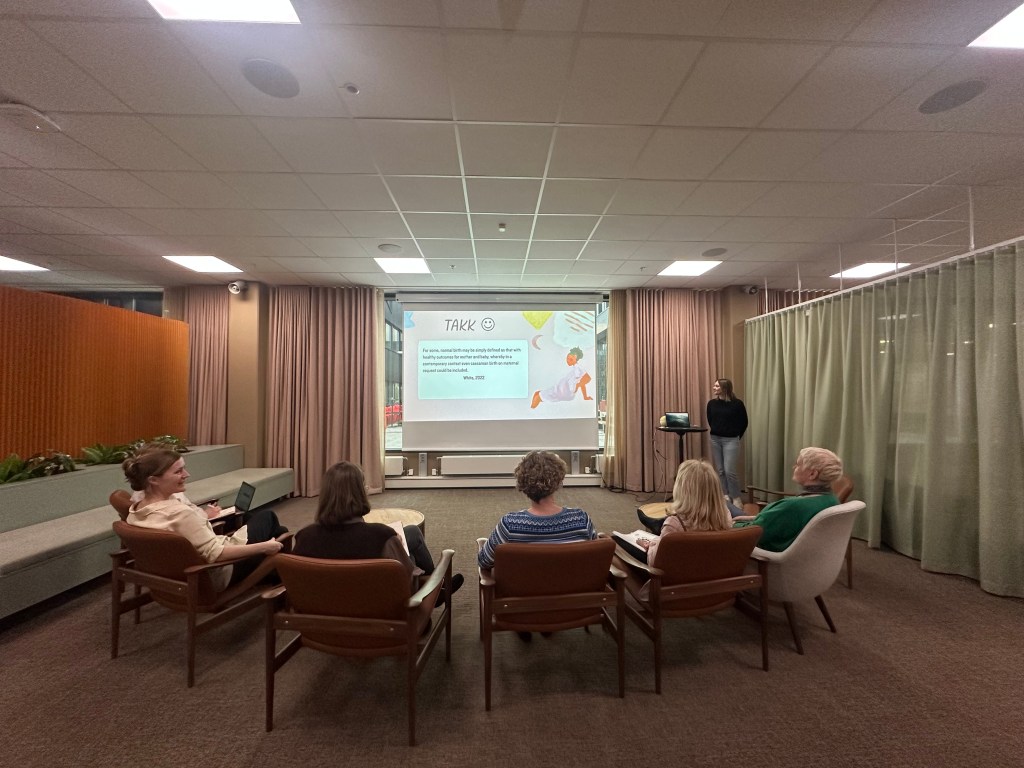
The picture was taken at our project meeting in Bergen, Norway, at Western Norway University of Applied Sciences in March 2026. Here, our master’s student in midwifery, Madeleine Lid Giil, presents results from her student project, which is linked to the Healthy Birth project.
The aim of the Normal Birth Project is to give a overall picture and a better understanding of what Nordic midwives consider a normal birth to be with the goal of promoting and supporting normal birth. The project also helps students to develop their knowledge of the global situation in relation to childbirth and the impact on Nordic midwifery.
A total of 145 midwives were interviewed by 35 midwifery students in the Nordic and Baltic countries (10 institutions in 7 countries). Our findings suggested a robust professional identity among midwives and prompted a re-evaluation of the term “normal birth,” leading us to advocate for the term “healthy birth.”
The first study from the Normal Birth project was published in the
official journal of the Swedish Association of Midwives, affiliated with the Norwegian Association of Midwives, the Danish Association of Midwives, the Icelandic Midwifery Association and the Federation of Finnish Midwives Sexual & Reproductive Healthcare in 2026. You can read the whole study here: Exploring views on normal birth in the Nordic and Baltic regions: a cross-national qualitative study with midwives working in hospital birth settings.
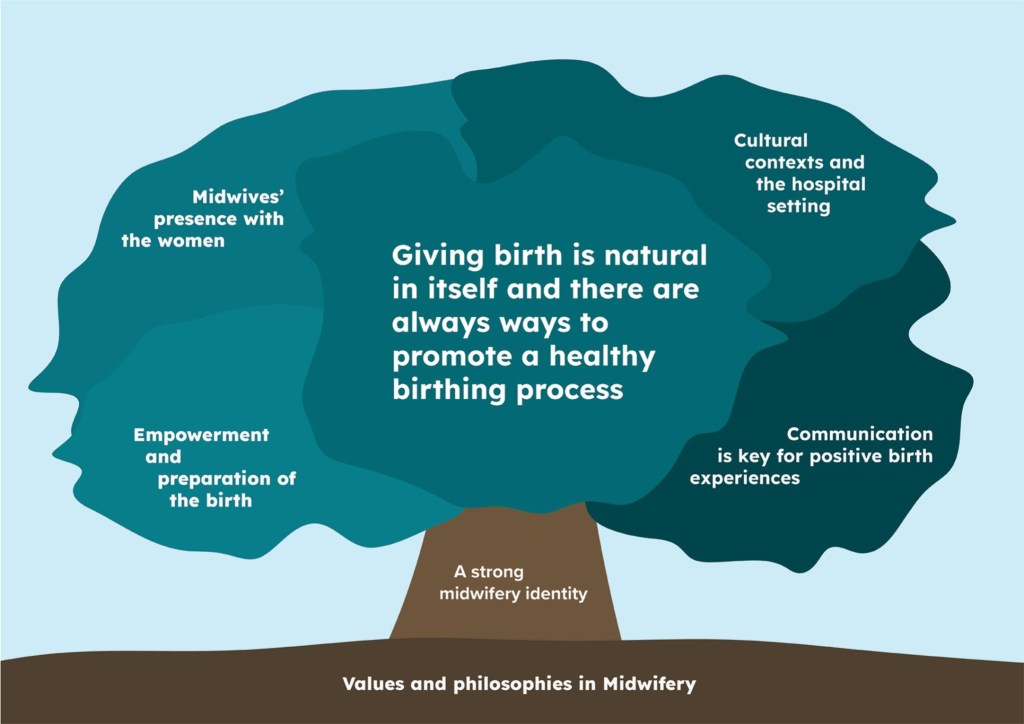
Fig. 1. The Nordic and Baltic tree of how midwives view, define and promote normal birth in a hospital setting. Illustration by Linus Andresson Vik.
Acknowledgements
We would like to thank former student midwives who collected data and participated in this cross-national project, devoting their time and passion. We would also like to thank the midwives who took part in the study. We extend our gratitude to the following newly qualified midwives: Emilia Huhtala, Mandi Haapaniemi, Ronja Söderbacka, Henrika Karjalainen, Erica Lamberg, Nella Gottberg, Ronja Julin, Sonja Piippo, Essi Salmensaari, Christel Björkbom, Emilia Johansson, Tova Biese, Elvira Backlund, Elin Seljeset, Kristine Gjerstad Sjøen, Amanda Thomasdotter, Sandra Stenberg, Undīne Meļikidze, Miļena Perfiļjeva, Beāte Agneta Kondratjuka, Emma May Morton, Melinda Blanco Ampuero, Ema Cilinskaitė, Kamilė Šumbarauskaitė, Gabija Karsokaitė, Saara Tuomivirta, Miranda Nordman, Hanne Grimsmo Pedersen, Mona Haukø, Karoline Christiansen, Randi Sollid, Anette Stokkan Overskott, Lisa Thomson Hattevig, Sunna Lif Guðmundsdóttir and Inga Ýr Óskarsdóttir for their participation in planning the study, collecting the data and analysing the results on a sub-study level. We acknowledge Alina Liepinaitienė as former lecturer in Kauno Kolegija Higher Education institution, Kaunas, Lithuania with her supervision of students.
Network Meetings
All educating partners will participate in the meeting as active partners within the network to share and decide how to allocate mobility funding and plan the joint course. The public hospital partners will attend the meeting which is essential as they bring real clinical situations to discussions and support with practical views on theoretical questions and be a part of new development within the network as well as be a part of mobility. This will strengthen Nordic-Baltic collaboration in midwifery education, sharing and developing evidence-based midwifery practices, and understanding the differences and similarities in the maternity services in collaborating countries.
Mobility
Exchange students apply for mobility according to their priorities and with mutual agreement between partner institutions.
Network Meetings
All educating partners will participate in the meeting as active partners within the network to share and decide how to allocate mobility funding and plan the joint course. The public hospital partners will attend the meeting which is essential as they bring real clinical situations to discussions and support with practical views on theoretical questions and be a part of new development within the network as well as be a part of mobility. This will strengthen Nordic-Baltic collaboration in midwifery education, sharing and developing evidence-based midwifery practices, and understanding the differences and similarities in the maternity services in collaborating countries.
Mobility
Exchange students apply for mobility according to their priorities and with mutual agreement between partner institutions.


